
Your Brain Cuts the World in Half Because It's Cheaper
You know the feeling: either I do it perfectly, or I don't do it at all. Either someone is a great person or they're an asshole. Either the diet is on, or one croissant ruins the day, and while we're at it, the whole week.
The middle is missing everywhere except in reality.
The rainbow that doesn't exist
Look at a rainbow. You see bands: red, orange, yellow, and down the list. They aren't there.
Physically a rainbow is a continuous spectrum. The wavelength changes smoothly, without a single seam. The bands appear at the moment the light reaches your visual system, and the system slices the spectrum into pieces.
This is called categorical perception, and it works like this: within a category differences get compressed, at the boundary they get stretched. Two shades seem similar if both are called yellow, and noticeably different if one is called yellow and the other green. The distance between them on the spectrum is identical either way.
The effect was first described in speech sounds in 1957, then found in colour, in faces, in musical intervals, even in how we tell shapes apart by touch. This isn't a quirk of vision. It's how the whole system works.
A label changes what you see
Here's where it gets uncomfortable.
In 1963 Henri Tajfel and Alan Wilkes showed people eight vertical lines. A staircase: each one slightly longer than the last, with the same step between neighbours. Participants were asked to state each line's length in centimetres. No opinions, pure visual measurement.
In the first condition the lines were simply shown. Estimates came out close to reality: a staircase looked like a staircase.
In the second condition the four short lines were marked with the letter A and the four long ones with B. Nothing else changed: same lines, same order, same step.
And the picture slid. People began to see the gap between the fourth line and the fifth as considerably larger than it is, with estimates diverging by twenty to thirty per cent. At the same time, lines carrying the same letter came to look more like each other than they are.
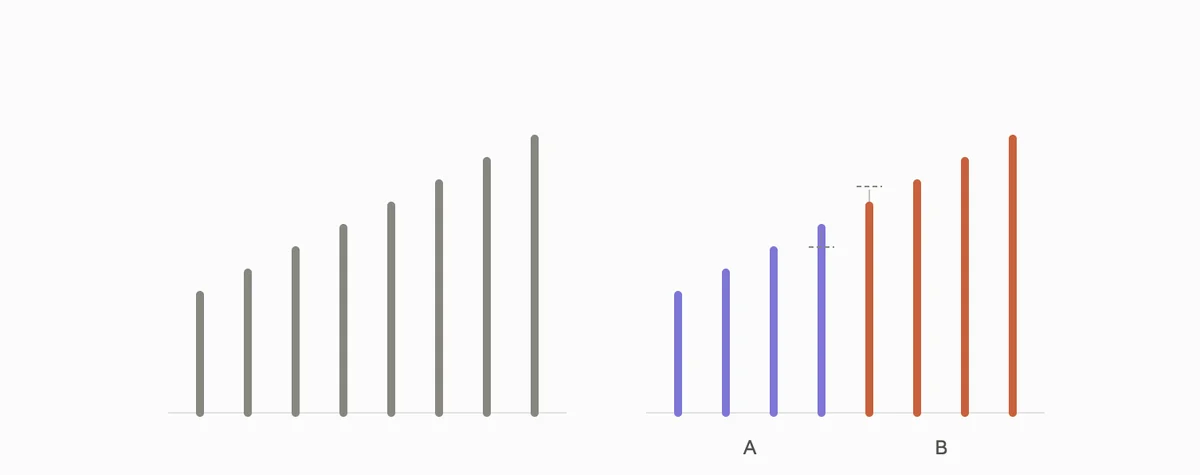
Physically, the step between the fourth and the fifth is the same as the step between the first and the second. The letters carried no information at all, the experimenter assigned them arbitrarily. But a boundary appeared, and with it a cliff that isn't there.
This is called the accentuation effect. And here's the part that matters: people weren't reasoning about the lines, weren't forming opinions about them, weren't judging them morally. They looked and named centimetres. The label acted on perception rather than on judgement, which is to say it acted before the person had time to think anything.
Now put a person in place of the lines. Or yourself.
Why the brain economises like this
The reason is the same as in the article on the spec, approached from the other side.
Sorting by shades is expensive. You have to hold a scale, compare positions, revise when new data arrives. Sorting into two piles is cheap: ours or theirs, edible or not, dangerous or not. In an environment where the decision is needed in half a second, cheap sorting beats accurate sorting every time, because accurate sorting doesn't finish in time.
There's a second detail that ties this cluster to the previous one. The less information a person has, the more heavily they lean on categories. Uncertainty doesn't only get filled with the worst version, it also forces simplification. So the two mechanisms work as a pair: first the data runs short, then the little that's left collapses into two piles.
The formula for this cluster: a continuum gets cut in half, and the middle stops existing. The four traps below are one operation running on different material.
Four traps in this cluster
1. Black-and-white thinking. The scale collapses into two poles
What it feels like. There's only perfect and terrible. The middle isn't rejected so much as invisible, the way the space between colours in a rainbow is invisible. Seventy per cent done isn't "not bad", it's "failed".
Example. You decided to run three times a week. You ran twice, and on the third day it rained. By evening the wording isn't "two runs out of three", it's "I couldn't do it again".
When it isn't a trap. When there genuinely is no scale. The contract is either signed or it isn't. The plane either took off or it didn't. Some things are binary by construction, and pretending they have shades is its own way of lying to yourself.
What helps. Bring the scale back physically: name a percentage. Not "failed" but "did seventy per cent of it". A number works better than reassurance, because you can't say a number and stay in two poles. Second question, if percentages don't apply: what would count as four out of ten here, and what would count as eight?
2. False dilemma. Many options reduced to two
What it feels like. Similar to the previous one, except what collapses isn't the judgement but the choice. Either I put up with this job or I quit into nothing. Either I keep quiet or I start a fight. The third option isn't visible, so it feels as though it doesn't exist.
Example. You're unhappy with how tasks are shared out in the team. Two options are in your head: put up with it, or write a resignation letter. Between them sits a dozen steps that never get considered: talk to your manager, ask for one specific task to be reassigned, move to another project, wait until the end of the quarter.
When it isn't a trap. When there really are two options and you've checked. It happens: deadlines, money, someone else's decision. A dilemma becomes false not because the options are few, but because nobody looked for them.
What helps. Make yourself write down a third option. Not a good one, any one. A fourth usually turns up after the third, and by the fifth the original pair stops looking exhaustive. A useful question: what would someone who doesn't care about this situation do?
3. Labelling. An action becomes a type of person
What it feels like. There was an action, now there's a definition. Not "I forgot to send the email" but "I'm irresponsible". Not "he raised his voice" but "he's an asshole". A label is convenient because it closes the question: there's nothing to do with a definition, it simply is.
Example. You were late to a meeting. Being late is an event, it has a cause and a consequence, something can be done about it. "I always let people down" is a property, and it doesn't get fixed, because there's nothing to fix, that's just you.
When it isn't a trap. When the label sits on consistent behaviour rather than an episode. Someone who has lied to you ten times isn't "someone who once said something untrue". The generalisation there rests on data instead of replacing it.
What helps. Put the verb back in place of the noun. "I'm irresponsible" turns into "I forgot to send the email". The difference isn't cosmetic: a verb has a time, a place and a cause, a noun has nothing but a verdict. And remember the lines: a label changes what you see, not only how you talk about it.
4. Overgeneralisation. One case becomes a category
What it feels like. The event happened once, but it gets described with "always", "never", "every time", "everyone". A category is created from a single example and then runs as a rule.
Example. One awkward conversation with a new team turns into "I'm no good with people". From then on it isn't an observation but a filter: every new introduction passes through it, and confirmation is easy to find.
When it isn't a trap. When "always" survives a count. If you've dropped every exercise routine in week three for five years running, that isn't overgeneralisation, it's statistics, and it deserves attention.
What helps. Catch the marker word. "Always", "never", "every time", "again" - each one calls for a recount. How many times actually? Usually it turns out that "always" means three occasions in two years, and "never" means it didn't work once.
What they have in common
Four names, one operation.
Black-and-white thinking collapses the judgement. False dilemma collapses the choice. Labelling collapses a person into a single property. Overgeneralisation collapses time: one case starts describing every case.
The same thing happens each time. A continuous quantity is replaced by two categories, the middle disappears, and the boundary between the categories inflates. Exactly what happened to the lines when the letters were attached.
And the consequence worth holding on to: arguing with the content is useless here. Convincing yourself you aren't irresponsible almost never works, because the label has already changed what you see, and confirmation arrives instantly. Something else does work: don't dispute the category, restore the scale it replaced.
What to do: bring the scale back
Four techniques, all about the same thing.
Name a number. A percentage, a rating, a count of occasions. A number can't be spoken from two poles, it creates a scale by itself. "Seventy per cent done" and "failed" describe the same event, but the first one allows a tomorrow.
Find a third option. Not the best one, any one. The task isn't to choose it, it's to break the pair. Once there are three options, it turns out there are eight.
Swap the noun for a verb. A property becomes an action, a verdict becomes an episode. "He's an asshole" ends the conversation. "He raised his voice in the meeting" starts one.
Recount your "always". Marker words get checked with arithmetic, and arithmetic is almost always on your side.
And separately, about where categories are useful. An engineer sorting parts into "within tolerance" and "defective" isn't falling into a trap, they're saving time where shades aren't needed. The difference is the tolerance: a boundary known in advance, written down rather than appearing on its own. The trap starts where the boundary shows up arbitrarily, like the letters A and B on the lines, and then begins to govern what you see.
Next: Your Brain Keeps Two Sets of Books - the third cluster, on why income and expenditure are counted in different currencies.
References
- Tajfel H., Wilkes A.L. Classification and quantitative judgement. British Journal of Psychology, 1963.
- Liberman A.M., Harris K.S., Hoffman H.S., Griffith B.C. The discrimination of speech sounds within and across phoneme boundaries. Journal of Experimental Psychology, 1957.
- Corneille O., Klein O., Lambert S., Judd C.M. On the role of familiarity with units of measurement in categorical accentuation: Tajfel and Wilkes (1963) revisited and replicated. Psychological Science, 2002.