
Your Brain Is Working to Spec. The Spec Was Just Written for a Different Environment.
You're Homo sapiens. Or Homo erectus. Or whichever ancestor paleoanthropologists are still arguing about. Doesn't matter. What matters is that you're standing in an open African woodland a hundred thousand years ago: dry grass up to your waist, thorny bushes, a river behind them.
Suddenly one of the bushes moves!

You have half a second and two options. Option one: you decide it was just the wind and keep walking. Option two: it's a lion, so you run for your life, jumping out of your pants. Although what am I saying, you don't have any pants yet.
Never mind! You can be wrong either way, only the cost of being wrong is very different. The population of those who kept deciding it was probably just the wind shrank rather dramatically.

Natural selection kept the alarmists, and they're the ones who became our ancestors.
That selection is exactly why your brain falls so easily into what we now call cognitive traps.
What a cognitive trap is
Imagine a smoke detector wired to a fire suppression system. The detector has a threshold. Below it, the detector stays quiet. Above it, the alarm screams, the sprinklers flood everything in sight, and people in pajama pants come running into the hallway clutching their pillows.
So a cognitive trap, the kind your brain falls into, isn't a broken mechanism. It's a danger detection threshold calibrated for conditions that no longer exist.
Your brain is working to spec. The spec was just written for a different environment.
And yes, all of us fall into these traps. Not only people with ADHD, not only anxious people, not only people who slept badly last night. EVERYONE, because this is part of the default design.
Two mistakes, two prices
Back to the bush. There are two ways to be wrong.
First: mistaking a lion for the wind. The price: you. And every child you might have had.
Second: mistaking the wind for a lion. You panicked for nothing, ran for nothing, burned energy and looked ridiculous in front of your people. The price: a handful of calories and a minute of panic.
In evolutionary psychology this is called Error Management Theory, and its central observation is simple: the costs of those two mistakes are catastrophically unequal. Selection didn't favour those who were wrong less often. It favoured those who were wrong more cheaply.
Run from the wind three hundred times and from an actual lion on the three hundred and first, and you live to old age and leave children behind. Walk calmly past a rustling bush three hundred times... and on the three hundred and first you make a lion's day, while your descendants stay in the unrealised-plans folder.
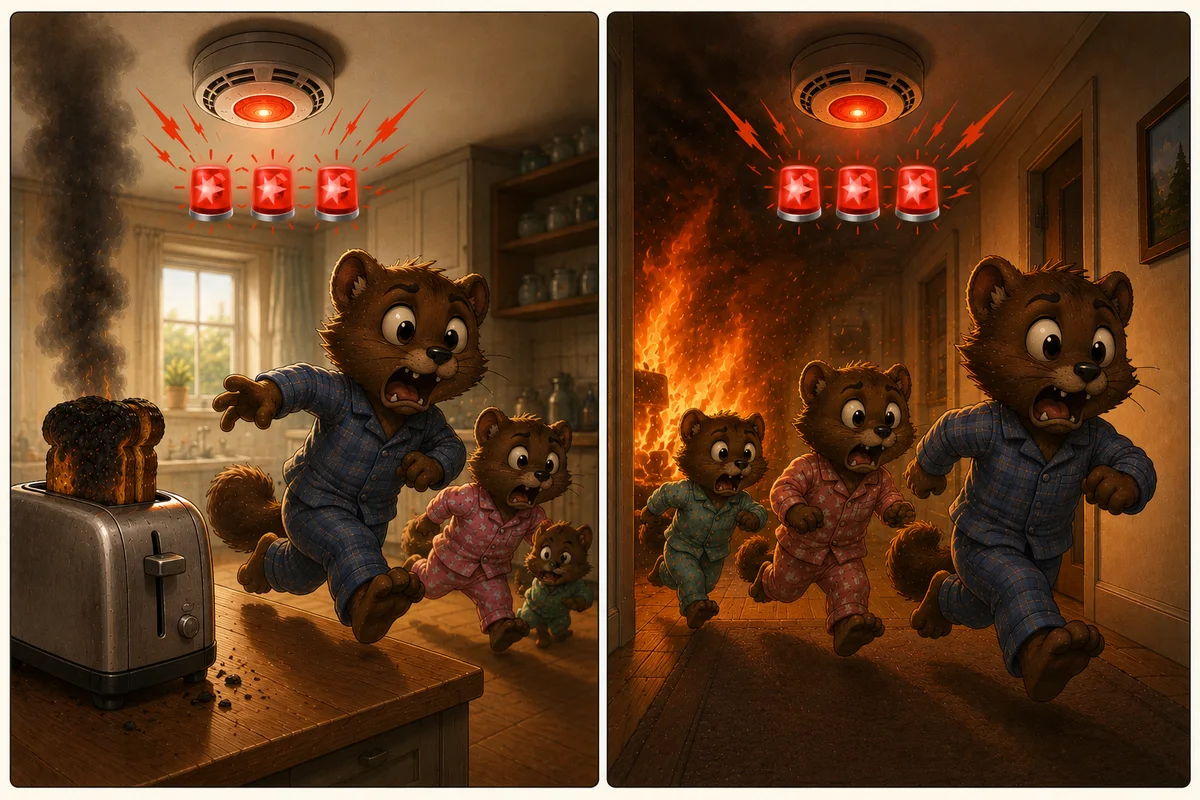
An engineer setting the sensitivity of a fire alarm follows exactly the same logic. A missed fire costs a house. A false alarm costs ten annoying minutes and a wet carpet. The costs aren't remotely comparable, so the threshold is set low on purpose, and the detector starts screaming at cigarette smoke and burnt toast.
A properly calibrated detector goes off for nothing more often than for a real fire. Fires are rare, toast burns constantly, so the overwhelming majority of alarms will be false. That isn't a defect. It's the price of never missing the fire that matters.
Evolutionary psychiatrist Randolph Nesse ran the same calculation for the body's defensive responses and, by his own account, didn't believe the result at first. It turned out that whenever a defence is cheap, false alarms should vastly outnumber responses to genuine danger. Not occasionally. Constantly. And that is the system's optimum, even though living with it feels awful.
Which leads somewhere most people never think to go. Anxiety in the queue at the post office, panic over an unanswered message, the 2 a.m. certainty that you'll be fired tomorrow. None of it means your mind is broken. It just means your mind did exactly what it was designed to do. Cheap response, low threshold, plenty of false alarms.
The optimistic scenario was never the priority, because it never saved anyone from a lion.
Why bad weighs more than good
There's a second half to the same setting.
Bad is processed more deeply than good, remembered more firmly and overturned with more difficulty. Psychologist Roy Baumeister gathered the research on this and went looking specifically for areas where good outweighs bad. He didn't find a single one. The paper is called exactly that: Bad Is Stronger Than Good.
Estimates of the weight vary, but the order of magnitude is consistent: a negative event carries several times the weight of an equally positive one. One criticism cancels several compliments. Ten people say you did well, one says "oh, that's bad", and by evening you're only replaying "that's bad".
Same logic as the bush. Good is pleasant but not critical for survival. Bad is critical. Your brain keeps its books so that no threat is ever lost, and mislays half the good news along the way.
This is where a whole family of traps comes from. One failed interview becomes proof that nobody wants you. One mistake in a report outweighs a year of solid work. One sentence in a chat cancels three years of friendship. None of it runs on logic. It runs on accounting, and bad has the higher exchange rate.
What changed
The spec was written for an environment where threats were physical, fast and unambiguous: predators, floods, fire and the rest. The response had to be instant: fight or run. The body was prepared accordingly: heart faster, breathing quicker, attention narrowing to a single point, blood pulled away from everything not immediately needed.
Threats of that kind are almost gone now. The system, however, hasn't gone anywhere and still runs on the same settings: low threshold, worst-case scenario first, reaction ahead of analysis.
Only now it fires on an unread message from your boss. On a deadline. On a cool "ok" in a chat. On a number on the scale. On the thought that you still need to book a doctor's appointment.
And it launches the full protocol: heart, breathing, tunnel vision, ready to run. The problem is that there's nowhere to run and nothing to hit, because the threat is an email. The response switches on completely with nothing to discharge it, so it stays in the body.
The detector is fine. There's no fire, there's a toaster.
What to do about it
You can't switch a trap off. It's architecture, not a habit, and no technique is going to rewrite something that took millions of years to assemble. Anyone promising to "cure your cognitive distortions in two weeks" is selling you a switch that doesn't exist.
What you can do is recognise the trap.
The moment you tell yourself "that's the detector going off, not a fire starting" changes a surprising amount. The reaction doesn't disappear: your heart is still pounding, the thought is still spinning. But it stops being evidence. Anxiety no longer means the danger is real. It means the threshold is low and the detector is sensitive.
That's where the engineering starts. In industry, a system behaving exactly as designed doesn't get blamed and doesn't get argued with. Its conditions get changed: remove the source of the false signal, cut the background noise, add a prompt, reorder the steps. The detector is left alone, because the detector isn't at fault.
Your head works the same way. You don't fix the brain. You change what reaches its input.
Twenty cognitive traps broken down: how each one looks from the inside, what it's trying to protect you from, and what to do when you recognise it in yourself.
All five clusters:
- Your Brain Can't Stand a Blank Space, So It Fills It With the Worst - catastrophizing, fortune telling, mind reading, the spotlight effect, projecting motives.
- Your Brain Cuts the World in Half Because It's Cheaper - black-and-white thinking, false dilemma, labelling, overgeneralisation.
- Your Brain Keeps Two Sets of Books - discounting the positive, mental filter, minimising, comparison.
- Your Brain Would Rather Blame You Than Accept a Meaningless Coincidence - personalisation, magical thinking, just world, shoulds.
- Your Reaction Is Not Evidence - emotional reasoning, tunnel vision, minimising effort, reverse telepathy.
References
- Haselton M.G., Buss D.M. Error Management Theory, 2000. On the asymmetry between the costs of type I and type II errors.
- Nesse R.M. The Smoke Detector Principle. Annals of the New York Academy of Sciences, 2001; updated edition: Evolution, Medicine and Public Health, 2019.
- Baumeister R.F., Bratslavsky E., Finkenauer C., Vohs K.D. Bad is stronger than good. Review of General Psychology, 2001.