The Village of Bories: How a Pile of Stones Became a National Treasure
ProvenceTravelHistory28 September 2026

The Village of Bories: How a Pile of Stones Became a National Treasure

Twenty-eight stone houses with no well, no church and no cemetery — built without a drop of mortar, and rebuilt stone by stone by a man who sold his house to save them.

Imagine a village of twenty-eight stone houses with no well, no church, and no cemetery. The nearest borehole gave no water — not because it dried up, but because there was never any water there. It is just a hole that was drilled and never became a well. The question is not who lived here. The question is why anyone would build a settlement where survival seems impossible. And if this is not a home, then what is it?

And more importantly, how was it built?
Watch the story

The video version

Read the story

A Village Born from Royal Decree

In 1766, King Louis XV signed a decree allowing the peasants of Provence to clear uncultivated land and turn it into fields. When you clear land here, you dig up tons of stone. All that stone had to go somewhere, and the peasants found a smart solution: they used it for building. Out of what everyone considered garbage, they built twenty-eight alien-looking houses — not to live in permanently, but as shelters during field work and seasonal grazing.

The site, located about 1.5 km west of Gordes, was known in the cadastre as the “hameau des Savournins” and in popular speech as “Les Cabanes”. It was not a permanent village but a seasonal agricultural complex. Each building had a precise function: housing for farmers, shelters for flocks, grain storage, tool sheds, and even silkworm farms.

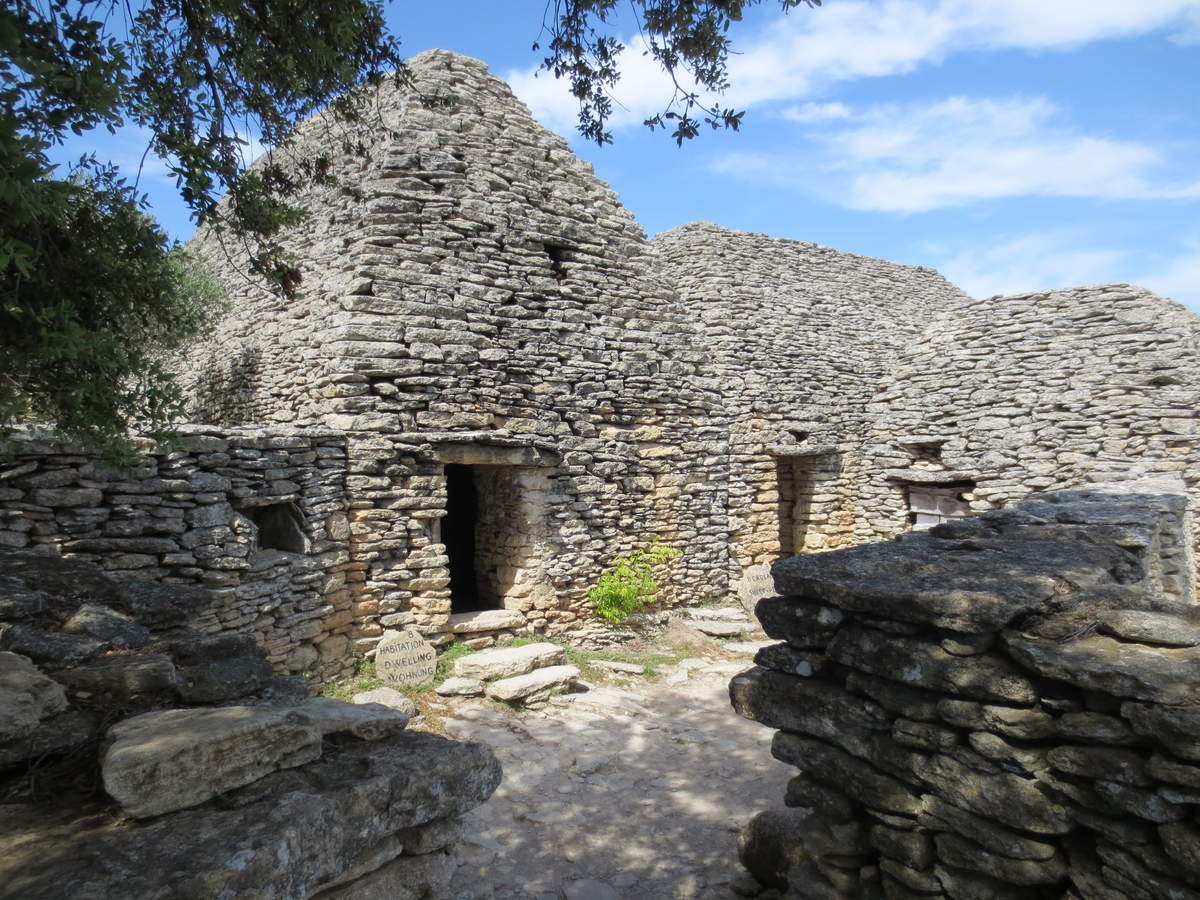
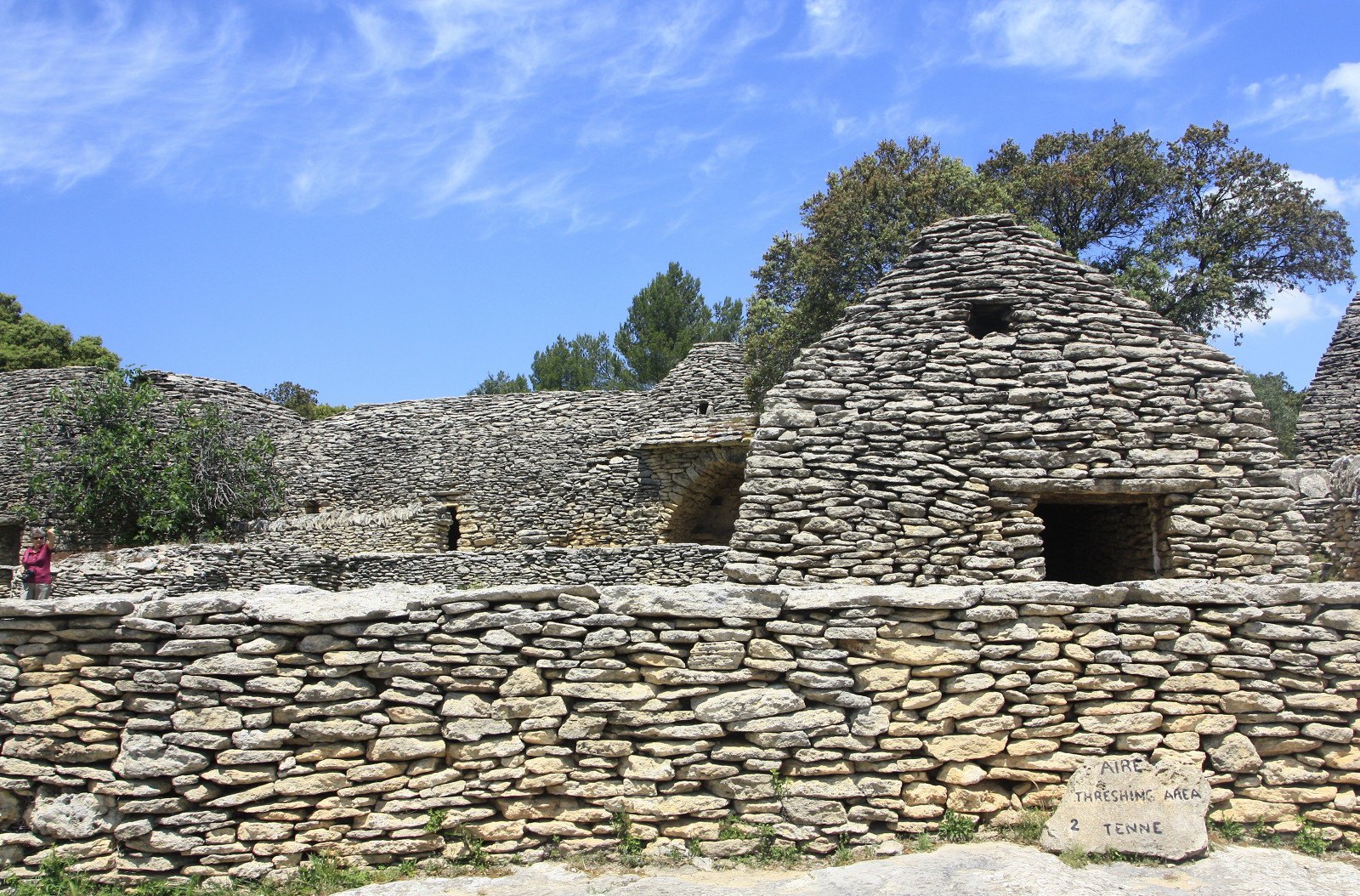
Dry stone huts of the Village des Bories near Gordes.

A Masterpiece of Dry Stone Geometry

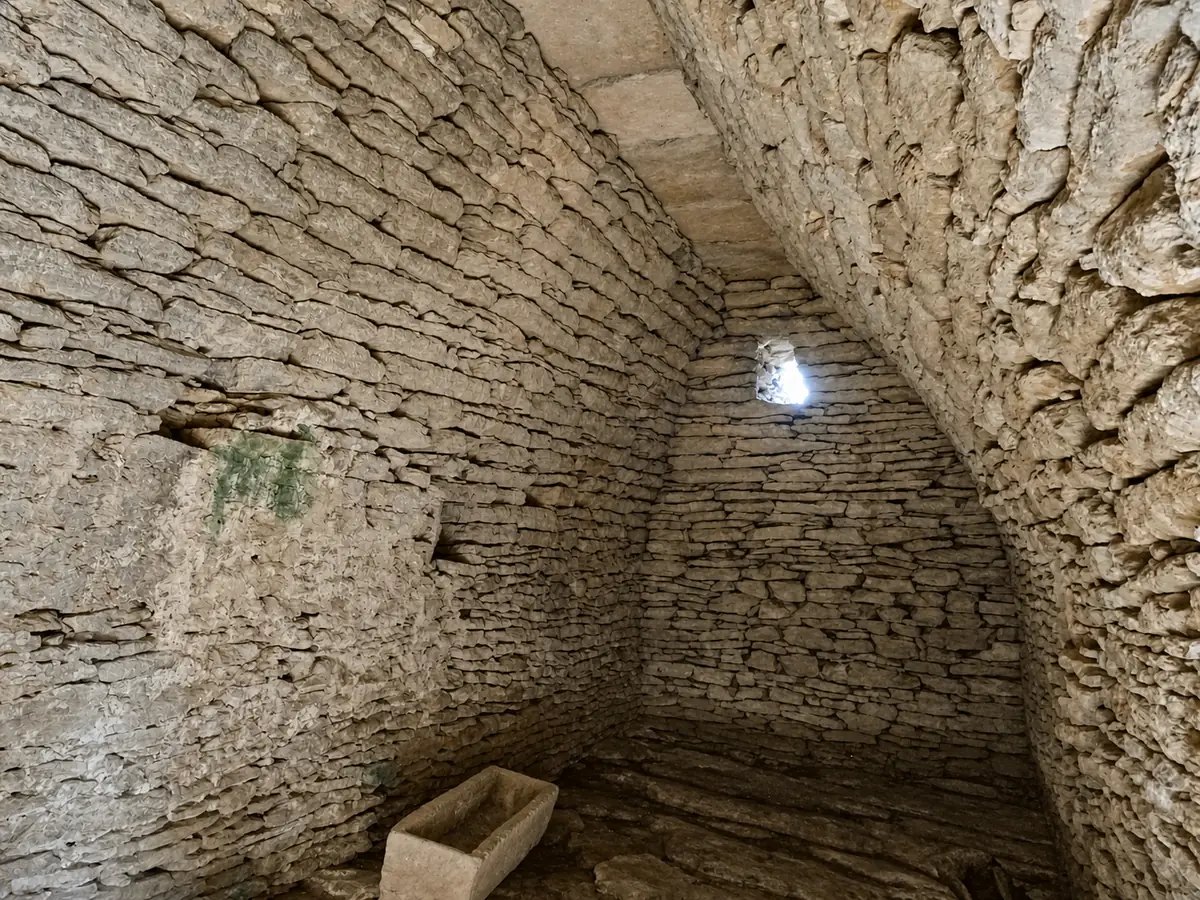
The construction technique is remarkable. These are dry stone huts — built without mortar, lime, or cement, using only the weight and geometry of the stone to hold together. The technique is called encorbellement (corbelling): flat stones of Burdigalian limestone, 10 to 15 cm thick, are stacked so that each ring advances slightly inward over the one below, closing into a vault.

Inside a borie: a corbelled vault held together without mortar.

If you needed a tool shed, you would build a cube of unmortared stone with a flat roof. But here you get inverted keystones, cones, and stone honeycombs. Why? Because a flat roof is heavy, and without cement the walls would kick outward at the corners and collapse. So they built cones. Each ring of stone is slightly narrower than the one below. Every stone pushes a little inward toward the center, jamming the whole thing together. The entire construction is an equilibrium of gravity, geometry, the weight of the stones, and their shape.

The underlying rock layers are horizontal — that is how they built the wall. But on top, stones were placed vertically, like a stop. The weight of the top row presses the whole construction down and keeps it from spreading apart. Water runs down the slanted faces, so the wall is not damaged by heavy rains.

These numbers show the sheer scale of manual labour. A single borie takes around 180 tonnes of stone — several truckloads, all lifted and laid by hand. Some huts contain up to 300,000 individual stones, each one found, carried, fitted, and placed so that it held its neighbours in place. Even a 6 m² room could hold 13 tonnes of stone. And walls up to 1.5 metres thick were not an excess: without mortar, it was mass and geometry that kept the vault from collapsing, while the thickness kept the interior cool in summer and warm in winter. This is not a pile of stones. It is an engineering system in which the weight, shape, and angle of every stone work together. That is why the restoration took eight years: rebuilding this without plans is like assembling a puzzle with no picture on the box.

Pierre Viala: The Man Who Sold His House to Save a Village

The masters who built this left no blueprints and no names. We do not know who they were. But we do know who assembled what you see today.

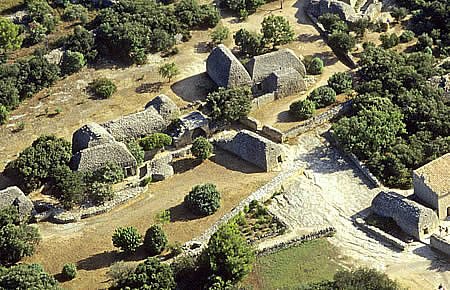
In 1968, Pierre Viala — a poet, actor, and globetrotter — bought the abandoned site parcel by parcel. He sold everything he owned to do it. The restoration budget was zero. So he went to the masons of Gordes and convinced them to help him restore the village. Between 1969 and 1976, over eight years, local masters took apart overgrown piles of stone and rebuilt them, trying to figure out how it had all stood three centuries earlier.

The Village des Bories from above — the site Pierre Viala rebuilt over eight years.

The task was monumental. The bories and walls had disappeared under invading ground cover. Dead mulberry and almond trees, oaks, junipers, and olive trees frozen in 1956 had formed such an entanglement that the rooftops were barely visible in the tangle. There were breaches caused by hunters who demolished walls to chase rabbits hiding between the stones. Two earthquakes — in 1886 and 1909 — had shaken the site, breaking lintels and cracking walls. Many bories had been built without foundations on soft foliated limestone, and growing roots had lifted stones and created voids.

The restorer used no newly purchased stones. He used only the stones found right there on the land. The stones were selected according to their patina and texture to match the material and colour of those being restored. It was a puzzle without a picture on the box.

In 1983, Viala ceded the village to the municipality of Gordes. In 1984, the commune became the owner and manager of the site.

Recognition and Legacy

The Village des Bories was classified as a Historic Monument in 1977. The restoration received an award from the French Academy of Architecture. In 2018, UNESCO added the art of dry stone walling to its Intangible Cultural Heritage list.

Today, more than 100,000 people visit every year. It is one of the most original tourist sites in Provence, with a collection of everyday objects and old agricultural tools on display.

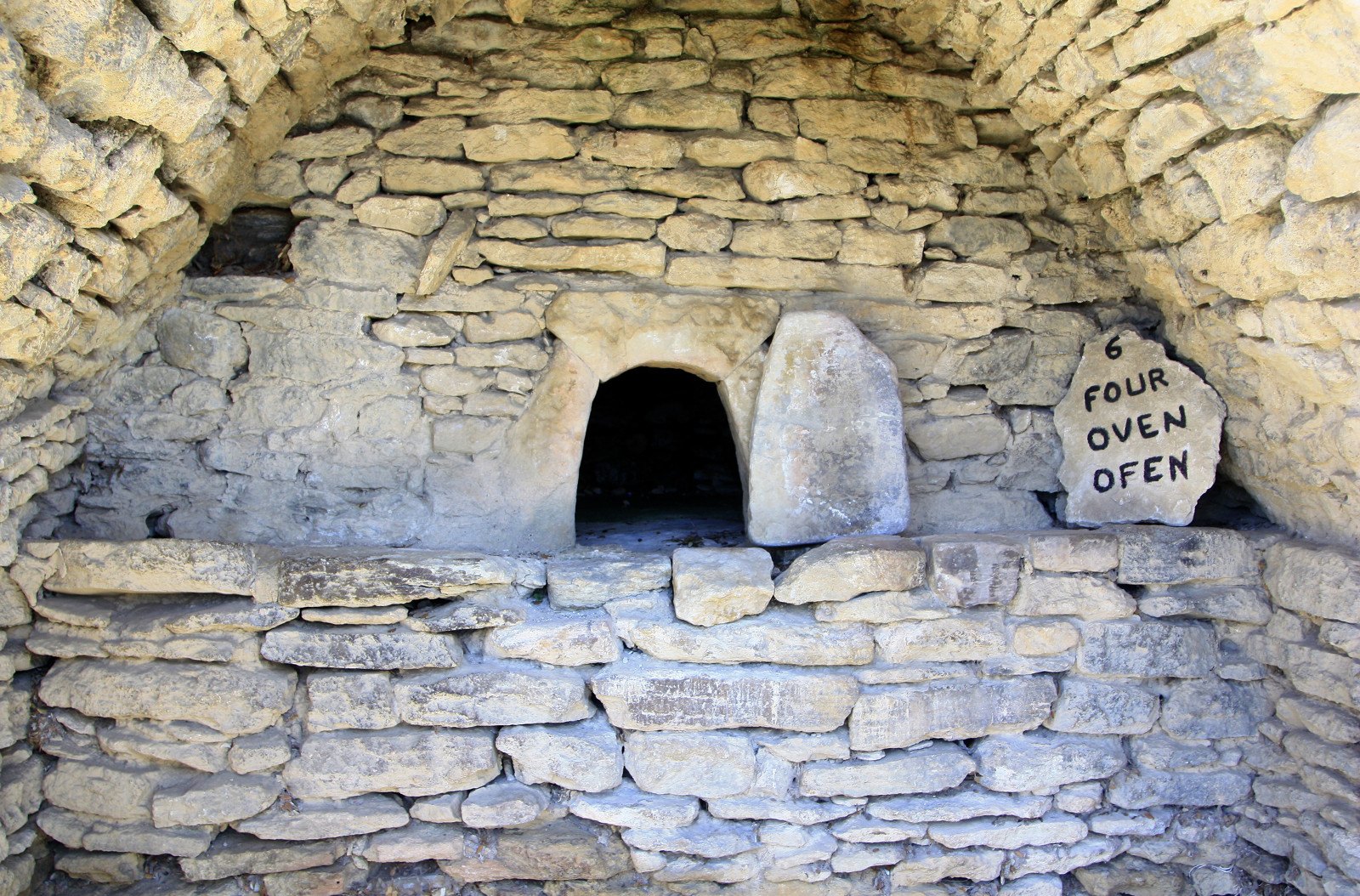
The village bread oven.

This is how piles of garbage became a national treasure. And all because one man sold his house, talked the masons of Gordes into helping, and spent eight years assembling someone else's puzzle.

The Contrast That Haunts

But driving home from the Village des Bories, starving and looking for a village to grab lunch, we found one on the map — a tiny place off the main road. We drove in hoping for a cafe, bakery, or anything. But the village was half asleep. Every fifth house was abandoned, and there was a children's sanatorium. We walked inside empty corridors. The building is still standing, but it feels like it is full of ghosts. Ghosts of a past life.

What hit us was the contrast. The Village of Bories is 15 km from here — a place where no one ever lived permanently, just seasonal huts for shepherds and farm workers. And today it is more alive than an actual village. In France, one in five homes in small communes stands empty. It scares me. The village is dying, and villages are not just dots on the map. They are our connection to the land. They are the cradle. We all come from places like this. And when they die, something in us dies with them.

This is the Luberon — a land of contrasts where abandoned villages lie just a few kilometers from towns full of life, where stories of loss and disappearance are hidden beneath endless blue skies and brilliant sunlight. From above, everything looks peaceful: the mountains, the old stone villages scattered across the landscape.

Perhaps this is what makes the Luberon so strange and beautiful. Tragedy and serenity exist here side by side, almost lost in the vast beauty of the landscape.

What we used on this trip

Continue exploring

Related stories