Twice a day the sea reveals the road to the fortress. Twice a day that road becomes a death trap.
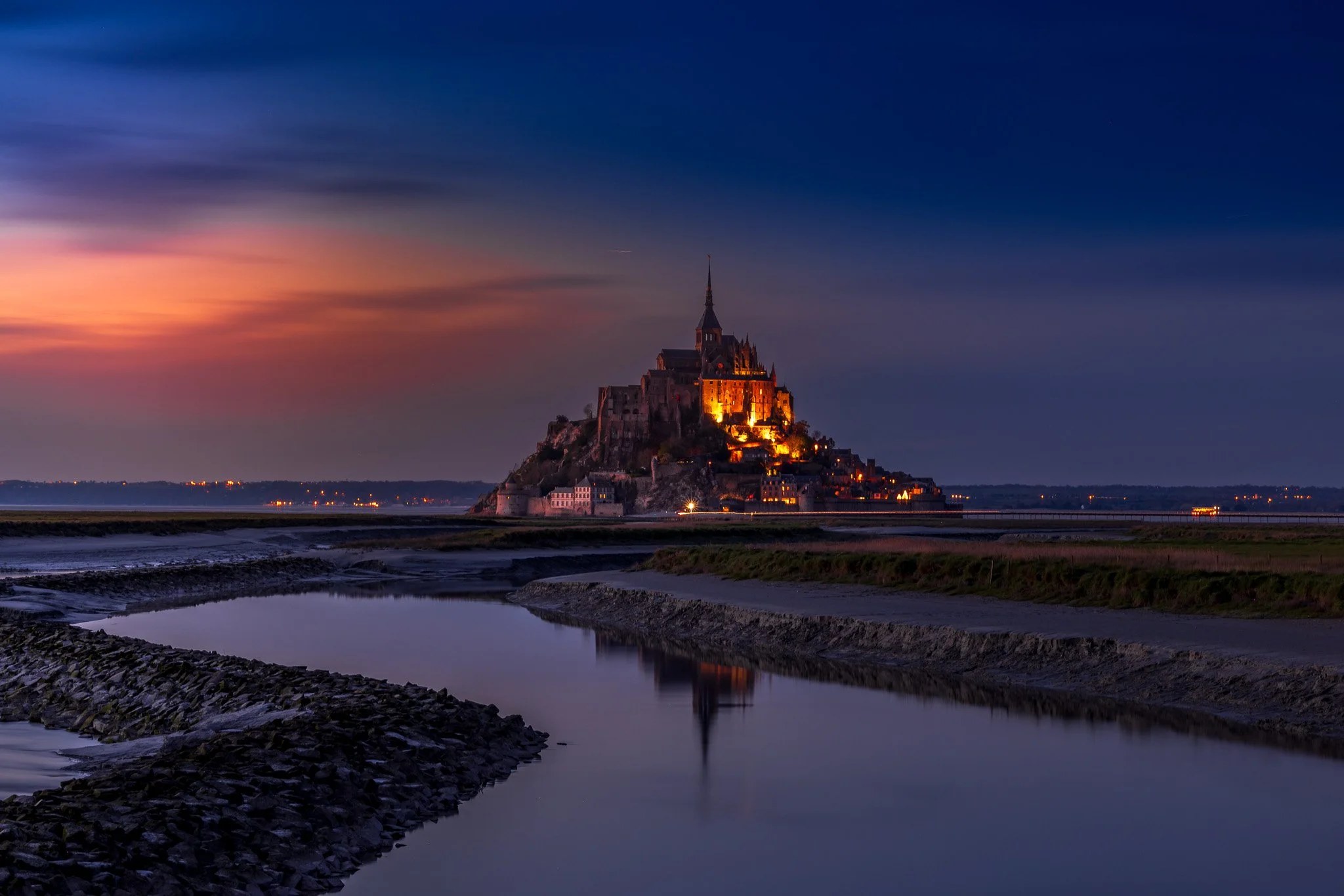
Twice a day the sea retreats, revealing the road to the fortress town of Mont-Saint-Michel. And twice a day that road turns into a death trap. A few hours before the tide you can walk here along the seabed, on sand that looks like solid ground but behaves like liquid. In the year 708, Bishop Aubert founded the first sanctuary here. Thirteen centuries later, millions of tourists come to see the abbey floating above the bay.
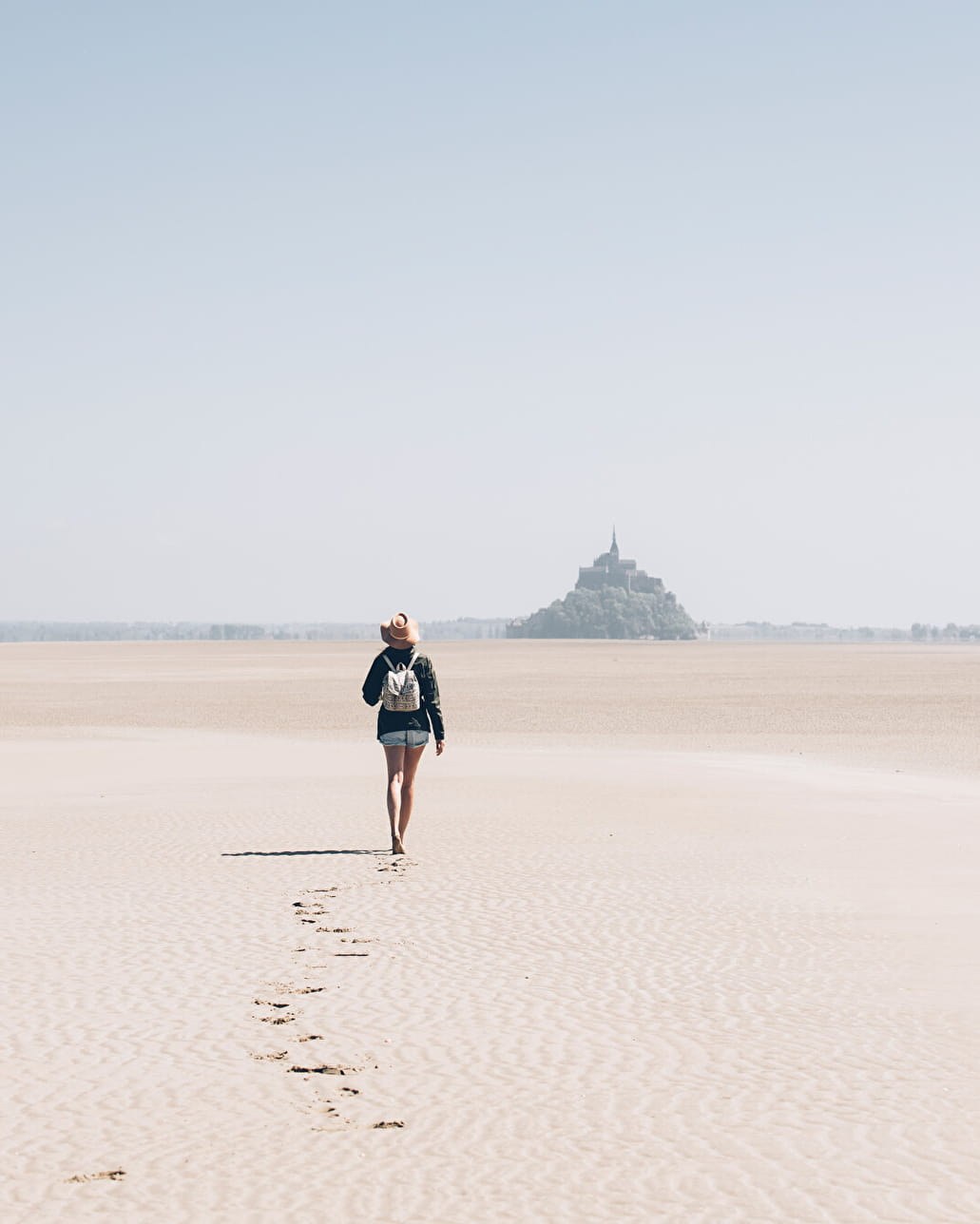
Crossing the bay at low tide: the sand looks like solid ground.
But this killer has accomplices. To see them, we will descend to the bottom of the bay, look into the sand, then into a skull, and finally into the story of how man tries to stop time.
Medieval pilgrims said the tide in the bay of Mont-Saint-Michel comes in "at the speed of a galloping horse." This is not a metaphor. The bay is a hypertidal environment: the average tidal range here is about 10 metres, around 12 metres in average spring tides, and up to 14–15 metres in exceptional cases. For comparison: that is the height of a five-storey building.
The bay covers about 500 square kilometres. It is a shallow estuary less than 20 metres deep. Three rivers, the Sée, the Sélune and the Couesnon, flow into the eastern part of the bay, but their annual discharge is only about 1.5% of the volume of water that swings back and forth with the tides. It is the tide, not the rivers, that rules life here.
Tidal current speeds vary from 0.3 to 0.7 m/s over the flats, but in the channels between tides they can reach 2.5 m/s. That is the speed of a brisk walk — but of water, not of a person. When the tide returns, it fills the channels first, cutting the sandbanks off from the shore. People caught on a bank suddenly discover that the way back is blocked by water moving faster than they can walk.
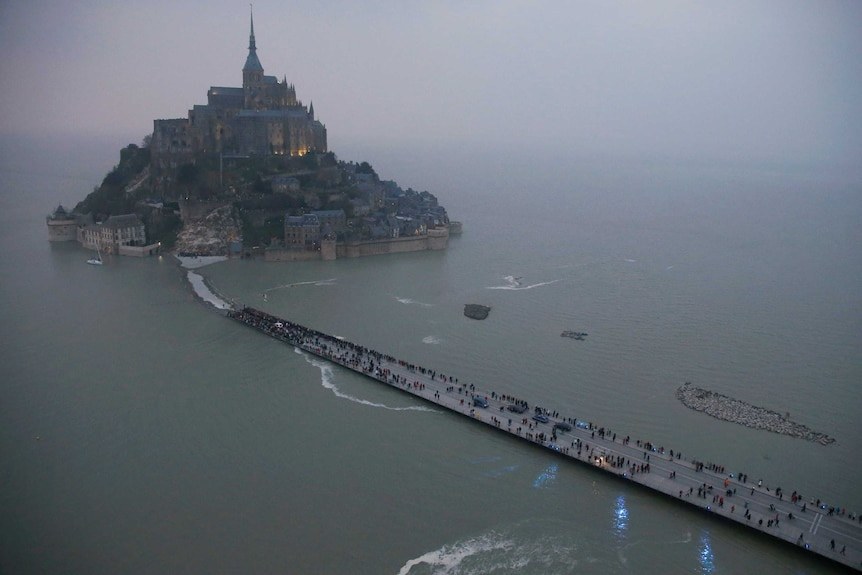
The supertide of 21 March 2015: the Mount became an island again.
The water is the first killer. But it recedes. And then the second one steps in — the one that looks like postcard-white sand. It does not drown you. It holds you.
2. Sand that does not drown you, but holds you
In the movies, quicksand swallows a person whole in seconds. In reality it works differently — and that is exactly what makes it more dangerous. The mixture of sand and water provides enough buoyancy to keep part of the body above the surface. Usually it is the legs that sink, sometimes up to the waist. But once you are stuck, the sand around your legs compacts and squeezes them like wet concrete. Pulling a leg free is impossible: the suction holds it with a force of hundreds of kilograms.
Quicksand is a non-Newtonian fluid: its viscosity changes depending on the force applied. A sharp tug makes the sand "seize up." Slow, gradual movement lets the sand "flow" around your leg. That is why the survival instructions read like this: lie on your back, spread your arms, and slowly free your legs one at a time. Slowly. And therein lies the whole problem, because while you are freeing yourself, the tide is already coming back.
The danger of quicksand is not that it will drown you. The danger is that it delays you just long enough for the water to do the rest. The surface of the sand here is not uniform: darker, wetter or slightly glistening patches may mean less stable ground than it appears.
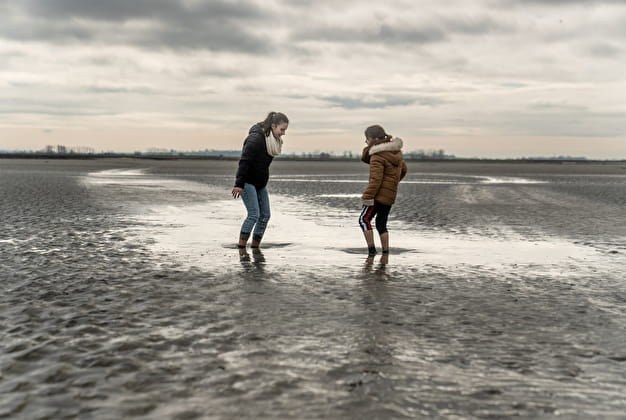
Darker, wetter, glistening patches of sand can be less stable than they look.
In the bay, rescuers use a vehicle that will not sink into the sand. Its wheels are nearly the height of a man. An ordinary car would sink almost to its doors, but this machine weighs more than a tonne and still puts less pressure on the sand than a regular automobile. The secret is in the huge soft tyres: like snowshoes that keep you from sinking into snow.
But even the most perfect machinery does not cancel out the statistics. In 2024, along the entire Channel and North Sea coast, 407 people were cut off by the tide. Three died: a yachtsman, a swimmer and a fisherman. These figures do not concern the bay of Mont-Saint-Michel alone, but they show the scale of the threat. In 2025, a dedicated VHF channel was launched for the Mont-Saint-Michel rescuers. Thanks to this marine radio link, everyone involved — guides, firefighters, gendarmes — can reach each other quickly. "This is the first season we have used this channel, and it makes our work considerably easier," says Thomas Bounissou, company commander of the Southern Manche firefighters. The guides are in the bay every day and can give rescuers precise information from the spot.
Sand and water explain how people die here. But they do not explain why an abbey appeared on this rock in the first place. The answer, strange as it seems, begins with a skull. With a hole in it.
3. How an angel persuaded a bishop by trepanning him
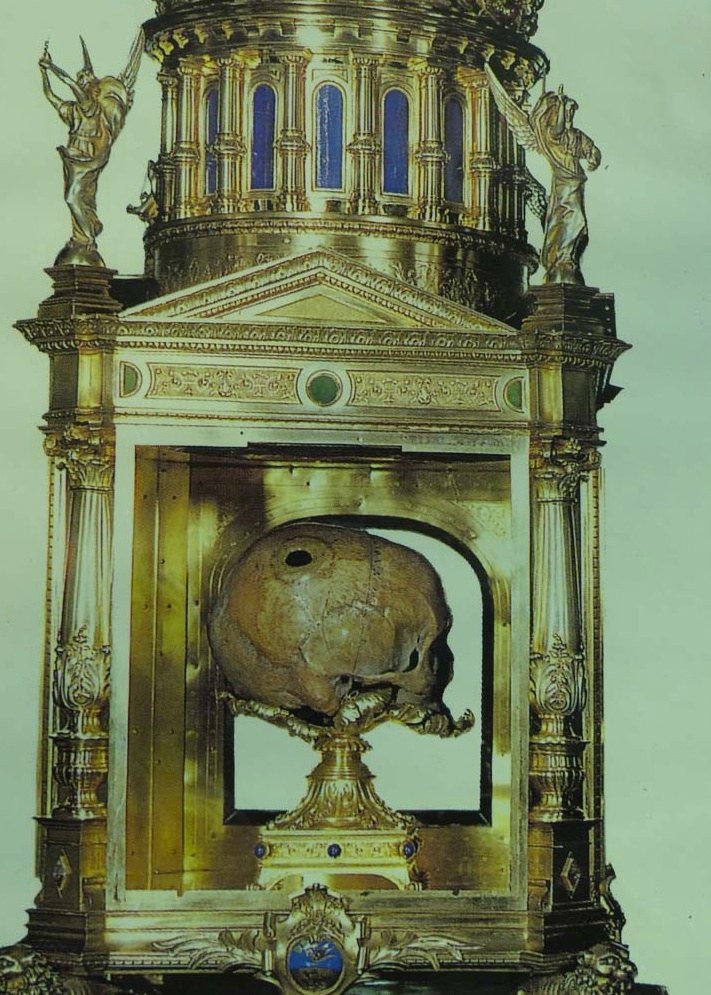
In Avranches, in the church of Saint-Gervais, under glass, lies a human skull with a large, perfectly round hole. Legend has it the hole was made by the archangel Michael with his finger. In 708, Bishop Aubert saw the archangel in a dream, who ordered him to build a church on the rock. Aubert woke up and apparently decided that dreams vary. Then Michael appeared again. And again. The third time, legend says, the archangel decided diplomacy was exhausted and resorted to violence: he drove his finger into Aubert’s head with enough force to perform a trepanation.
The skull of Saint Aubert in the basilica of Saint-Gervais, Avranches. The hole is still visible today.
The skull exists. So does the hole. When researchers ran the skull through a CT scanner, they found that the hole had indeed been made during the person’s lifetime. The edges of the opening had managed to heal and remodel — meaning he lived with this hole for years.
But here legend collides with science. An anthropological study in 2006 (the journal Pour la Science) confirmed that the hole appeared during life and that its edges had healed. However, the researchers rejected the trepanation version: the edges of the hole do not resemble a trepanation mark — they are convex, perfectly smooth, with no signs of inflammation. From the shape of the inner relief they concluded that the cause was most likely an epidermoid cyst, a benign tumour that had eaten through the bone.
Radiocarbon dating places the skull between 662 and 770 AD — the century of Aubert. In the eighth century, when some of the most effective medical procedures were bloodlettings, someone or something made a hole in a living person’s skull, and that person lived for years afterwards. The legend of the archangel’s finger stops seeming quite so absurd when you realise the alternative explanations are no less mysterious.
4. The sand returns: more than 200 million against time
In the nineteenth century, Mont-Saint-Michel began to lose its island status. In 1857 the underwater La Roche-Torin dam was built, and in 1878–1879 the causeway road connecting the mainland with the abbey. These structures blocked the natural circulation of the currents. The result: sand began to accumulate year after year. Every year a million cubic metres of sediment settles in the bay, and the bottom rises by 1–1.5 centimetres a year. Experts warned: if nothing is done, by 2040 Mont-Saint-Michel will be completely surrounded by land.
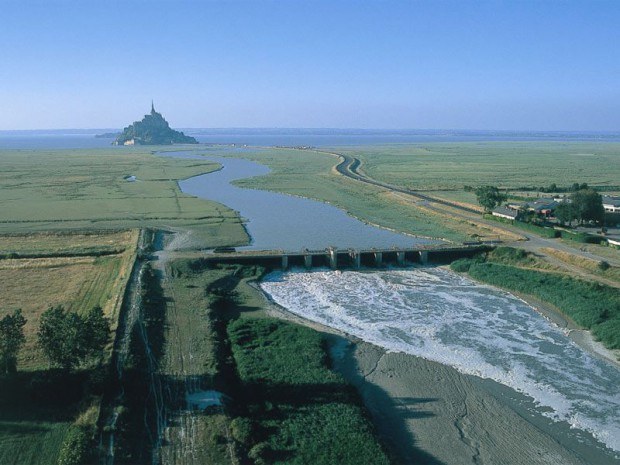
The French government spent, by various estimates, between 185 and 230 million euros on saving the island. The old causeway was removed, and a new dam was built on the Couesnon river, which helps flush sediment out of the bay. Twice a day the dam gates open: water is held back and then released into the riverbed, creating an artificial flood that carries the sand out to sea.
The dam on the Couesnon: twice a day its gates create an artificial flood that carries sand out to sea.
But the solution is not forever. The project does not eliminate the problem entirely: it affects a limited part of the waters, while the rest of the bay continues to silt up. Experts do not rule out that new measures may be needed in the future.
So Mont-Saint-Michel is not just a miracle. It is a miracle that checks every day who is in charge here. And if you decide to walk across the bottom of the bay, remember: the killer has a schedule. You only have a few hours.
What this means for the traveller
If you are planning to cross the bay, here are a few rules that could save your life:
Never walk without a guide. The guides know where the quicksand is, how the channels shift and when the tide begins.
Do not panic if you start to sink. Lie on your back, spread your arms, and slowly free your legs one at a time.
Watch the time. You only have a few hours between low tide and the return of the sea.
Keep a visual reference point on the sea. Have a means of communication to call rescuers: in France the maritime service CROSS is 196, VHF channel 16; the universal emergency number is 112.
Mont-Saint-Michel will remain a miracle, but a miracle that demands respect. Twice a day the sea retreats and returns. And twice a day you have a chance to see this place the way pilgrims saw it thirteen centuries ago — if you remember that here beauty walks hand in hand with death.